Showing posts with label AssignmentWeek1. Show all posts

Friday, March 14, 2014

Grow and shrink! Signs

Signage on my pieces: 


Sign (will be propped up like a mini science fair board on the side)

Love to hear your thoughts/ suggestions!

Wednesday, January 15, 2014

Mirror Exhibit Critique

Update: I think I just figured out how to label this post correctly, sorry about that.

Favorite:
I enjoyed many of the mirror exhibits at the Exploratorium, but one of my favorites was the Through the Looking Glass exhibit. It is made up of four different activities that encompass many of the properties of mirrors. I like the idea of an exhibit having multiple stations because it allows multiple users to interact with the exhibit at the same time. 


Through the Looking Glass has four different activities on each of its four sides There is a mirror maze, a chalkboard reflected in a mirror, an activity where the user has to trace spirals while looking at them through a mirror, and an activity where the user has to move a washer along a wire while looking at it through a mirror. All these activities are very simple and robust and could be replicated at home, which is another advantage that this exhibit has. I also liked how there are clear instructions at each station and explanations that tell the user what is going on.


The exhibit is very hands-on and the chalkboard activity lets the user leave a semi-permanent "mark" on the exhibit, which makes it feel more personal. This exhibit illustrates some of the basic properties of mirrors in very simple, straight-forward way. I found Through the Looking Glass to be a very effective and fun exhibit.


Least Favorite:

I did not particularly like the Look into Infinity exhibit. The exhibit is small and flat and unfortunately it was easy to miss since it was pushed up against a wall behind the Giant Mirror. Infinity mirrors can be very interesting and look really cool, but this one did not impress me. The instructions were unclear and the exhibit lacked a good explanation of what was going on. Some of the other exhibits had brief explanations describing how the "trick" worked or the scientific phenomenon that the exhibit was portraying, which I think is very useful and educational. These explanations are short and clear enough so that the user can easily learn something new without losing interest or becoming too confused; the Look into Infinity exhibit could have used something like that.


Another issue I had with this exhibit is that it did not hold my attention for very long. I just looked through the holes and then I was ready to move on. I saw another museum visitor approach the exhibit. She didn't even bother to look into it, just read the little blurb and continued to the next exhibit. It might be relevant to add that this exhibit (which is black and rather boring-looking) is located next to the Anti-Gravity Mirror exhibit, which is a large, eye-catching mirror that looks a lot more inviting. If I were to redesign the Look into Infinity exhibit, I would add some colored lights or something more interesting to hold the user's attention as they looked at it. I would also embellish the outside of the exhibit to make it more appealing and eye-catching. I would add an explanation of how the mirror works and improve the instructions to make them clearer. The concept of an infinity mirror is very cool, but I think this exhibit missed the mark in its portrayal.

Tuesday, January 14, 2014

Exhibit Critique

Your Father's Nose

This exhibit involved two people  sitting down facing each other across a table with a series of mirrors separating the two of them. The two participants have to adjust their position till they see a composite image of their own face and their partners. The exhibit is trying to illustrate the fact that genes for specific features are expressed discretely and not as a blend. The very nature of the exhibit is interactive as you need a partner for it to function. I noticed a lot of laughing and communication in general. The exhibit really seemed like it was bringing people closer together and I think that is really cool! The reason I think this exhibit did not work as well is because of the variation in heights between people sitting on the wooden chairs. I did it with Dan who is considerably taller than me and it was a struggle to get our faces on the same level. Similarly, I observed a young boy try to do it with his dad and was left frustrated because his father was just too tall for it to work. This exhibit has a lot going right for it, and a suggestion to make it work would just be some chairs that can be adjusted to raise and lower the participants to the same level.


"I see my eyes and your mouth"


Giant Mirror

My favourite exhibit like a lot of others is the giant concave mirror. It is such a simple yet magnificent object that creates a very memorable interaction. I found myself losing track of time playing in front of it. I was also captivated by seeing other's reactions to the exhibit. People had these huge cheesy grins while making faces at themselves and I thought that was just fantastic. The mirror had some great ideas to invite others into your experience like trying to high five or spiderman kiss each other. Another thing that I found fascinating was that even though everyone is looking at the same thing, they are seeing very different images based on where they are standing. I really enjoyed playing with the focal length jumping between being upside down and upright.


Two people trying to spiderman kiss. What I imagine Dan is seeing when he's looking at them

Exhibit Critique

Giant Mirror


This exhibit was probably one of my favorite simply because of observing others' reactions to and interactions with it—I rather enjoyed it as well!

First and foremost, it is huge: by its very nature, it is extremely inviting, and its location in the space is pleasing (i.e. because it is so large, it requires its own space and is not subject to very much cluttering by other exhibits). Furthermore, despite it being so large, it successfully keeps to itself in that it does not overly crowd the space, it is not so big as to be unnerving, and users still have to engage it before it engages them. In short, the exhibit owned its space without necessarily infringing on other exhibits as well as visitors: it was just the right size to attract passer-by and to achieve the desired effect, as well as a few others!

Second, this exhibit sparked my curiosity as a passer-by because there was enough space to allow me to watch others' interaction with it. I could feel wheels beginning to turn in my head, as well as the heads of those around me, simply watching other users engaging the exhibit. Perhaps one of the only downsides to the exhibit was that it had a decent number of people constantly flowing to it. I still believe the exhibit is designed to handle that amount of people, and by my observation people stayed for extended periods of time regardless of any “line,” probably because watching others in the mirror does not feel intrusive but rather creates this shared curiosity experience.

Therein lies the very strength of the exhibit. I believe that this exhibit strongly hits upon a creative, game-playing region in the brain. Something about it made me curious (and others I would guess by watching), not necessarily about how the exhibit works, but about what else I can “do” with it.

That said, I think the assistive text did a great job capturing this point. The explanation was concise and rather straightforward, but more importantly, there was an image of users doing the “spider-man kiss” and a challenge to recreate it. That challenge to keep playing games and find what else could be done was for me a great thrill in that I had a desire to understand what was happening so that I could achieve and see for myself more awesome pictures and scenes.


All Eyes on Me


This exhibit did not resonate with me. The notion is simple enough: sit in a chair in front of this circular vanity-like mirror composed of many smaller circular mirrors and position your eye in the center one so that all mirrors show your eye looking back at you.

First of all, I would like to give this exhibit the benefit of the doubt. It was situated very oddly relative to the rest of the mirror exhibits—in fact, relative to any exhibit near it. Pressed up against a corner next to a drumming exhibit, the only inviting aspects it had going for it were a pleasant enough looking piece—nice wood finish, bright lights around a mirror—and a stool.

After reading the assistive material, I decided it could be neat to see. Just about everything from that point on was uncomfortable about the exhibit: the stool is a lightweight wood box that is surprisingly flimsy, and though simple to adjust for distance, doesn't quite sit right; the lights are insanely bright and for a user actually trying to interact with the exhibit for an extended period of time they were almost painful on the eyes; nobody is coming to interact with you on the exhibit, and yet, its proximity to other exhibits feels like your exhibit engagement is being intruded upon by nearby visitors. Honestly, where the piece is in the museum almost makes it feel as if something about it doesn't belong and therefore the perception becomes negative (I don't belong), and I felt my mind becoming shut down to curiosity as it was so focused on the negative.


I think one of the main improvements that could be made to this exhibit is simply a change in location. There is a second exhibit I can think of for example that is related in material but also hidden though it was one of my favorite exhibits (Self-Centered and Self-Excluding mirrors). Though those are both hidden they are still inviting and are themselves situated in a more spacious, quieter corridor. I think as this is a sit-down-for-a-minute exhibit, it would greatly benefit from a little more space as opposed to how tightly it is currently situated amongst other irrelevant exhibits. Some thought may also be given to the angle of positioning in more space: do you want to see others while doing it? Do you want others to see you? Both of those are hard to answer since the exhibit depends on each mirror reflecting your eye. However, I think some more sharing could make the experience more positive, especially in overcoming the frustration of “getting it to work.” For instance, it could be very fun and funny to have the exhibit somehow share what you're seeing with passer-by or with other users of the exhibit so that now all eyes aren't just on you but also on them. This allows for discovery and game-playing, urging the question what else can I do? Whether that involves making people laugh or scaring people, I believe that the strength of interactions lies in sparking people's motivation to play.

Exhibit Critique

Rotating Faces. The exhibit looked simple enough.  Six pairs of mirrors aligned at different angles from each other, two pairs on each side of the exhibit with handles for rotating.  The objective of turning the mirrors was clear and evident from the beginning.  As I went to turn the first pair of mirrors, I saw what I expected, the mirrors rotated, but my reflection remained fixed.  Then as I went to turn the second set of mirrors I was shocked when I saw my whole reflection rotate with the mirrors as I spun them.  I even spun each mirror again just to make sure I had seen it right.  At this point, a fellow visitor experienced the same phenomenon and we tried to figure out why together.
"Why is my face upside down?"
Because the exhibit was set up in the center of the room and had three different sides, it allowed multiple groups of visitors to use it at the same time without being afraid of intruding on another persons experience.  Furthermore, the exhibit allowed visitors to interact with each other since the sides were close together and was low enough that they could talk over the exhibit and share thoughts.  What I found really cool was that each side of the exhibit had a different set of mirrors making it almost necessary to talk with other visitors or at least look at every side of the exhibit.  By making you walk around the exhibit to see the other mirrors, it was as if you were actually an explorer.

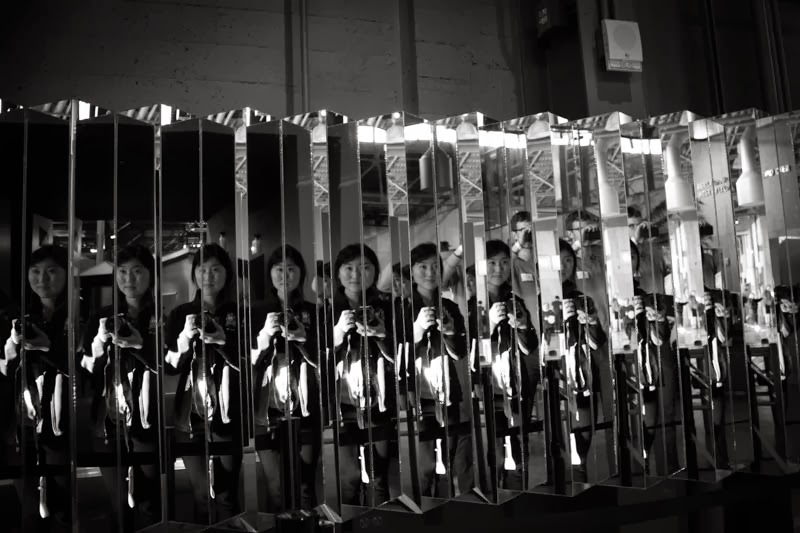
Self-Centered and Self-Excluding Mirrors. These exhibits were art installations that were comprised of a series of mirrors that showed only the visitor of showed none of the visitor.  I enjoyed the concept of a mirror that showed dozens of image of only one person as well as looking at a mirror that didn't show my image at all.  However, I think the exhibits could be greatly expanded upon.

"The Ultimate Selfie"
The exhibits were almost hidden, tucked away in the West Gallery against a the side of a wall.  As the mirrors look like nothing out of the ordinary, most visitors just walked by them without even glancing at them.  Either the appearance of these mirrors should be changed or they should be placed in an higher traffic area.  Perhaps placing them at the end of a path so that as a visitor walks towards it he or she sees his or her image.  Even placing a set of footprints in front of the mirrors could create more interaction with the exhibit so users know that they are supposed to stand in front of them.
"Where'd I go?"
Lastly, while I think the ideas of self-centered and self-excluding mirrors are very creative, I believe this project could have taken this idea much further.  The mirrors were quite linear and only stood about three feet tall.  Perhaps creating a set of mirrors that fully encompassed all of the visitor's field of vision would make the exhibit and idea more powerful.  Also, the mirrors were only self-centered and self excluding when looking left to right.  By either using curved mirrors or adding mirrors placed at different angles, the exhibit could be expanded to include a variety of dimensions.  These changes would also attract more visitors as it would make the exhibit look more like something out of the ordinary.

Assignment 1 (Mirror Critique)

Mirror Critique

Giant Mirror

While the giant concave mirror is a great toy, I felt like it lacked depth as an exhibit.  Last week we talked about two types of exhibits, those that you come away from feeling like you’ve learned something (ex : Bright Black), and those that are designed not to teach, but to spark curiosity (ex : Magnetic Sand).  The Giant Mirror exhibit did not seem to demonstrate any tangible phenomenon for learning, but also did not spark my curiosity to experiment more with mirrors.  I think it was intriguing, but lacked an explanation for the phenomena and as a result was unable to carry that curiosity to its prime.  There are a lot of Exploratorium exhibits that demonstrate magic in the world, but in this case I found it hard to think beyond the magic about the actual quality of the mirror and how it was distinctly changing my perception.

I think this exhibit could be improved by delineating areas of intriguing perception with lines on the ground and a more clear diagram of how a curved mirror reflects.  I felt like this particular exhibit had too much magic and mystery without ample explanation.  It was a really disorienting experience which made it exciting, but hard to grasp what was actually happening as you moved closer or farther away.  A simple diagram like the one seen above that visually demonstrates why the world is flipped in a concave mirror would be very beneficial to the exhibit. 

Rotating Faces

This exhibit was quite frustrating to me at first, but I think the frustration actually made it stronger.  It poses both a challenge and a delight by allowing you to see your face spin in some folded mirrors while having others that do not move your image.  The general premise of the exhibit is that the angle at which the mirror is folded changes the number of times a reflection passes back and forth.  I came back to this exhibit twice trying to fully grasp what was happening and was delighted by the suggestion to put your finger close to the fold in the mirror and count how many times you could see your finger, then divide that number by two.  If the resulting number was odd, then your face spun, but when it was even your face did not move when you looked into the fold and spun the mirror.  This worked really well for me because it frustrated me and then gave me a hint on how to solve that frustration and reach a climax of excitement after a moment of discovery. 

I think it was particularly strong because there were three sides to the exhibit each with two spinning mirrors, one that spun and one that stayed still.  My initial hypothesis was that the image spinning depended on the size of the angle between the two faces, but as I went around to the other sides of the exhibit I realized that there was no pattern between how acute an angle was and whether it spun.  This tricked conclusion built on my yearning to solve the mystery.  The exhibit was both successful on a learning level to demonstrate an interesting mirror quality to a user, and was successful on the curiosity level because it kept me coming back and wanting to discover more. 

Exhibit Critique

All Eyes on Me

 
This exhibit caught my eye as we were entering the museum, but upon interacting with it more closely, I found that it didn't work well for me. All Eyes on Me works as follows: a stool is placed in front of what appears to be a vanity cabinet, with an array of circular mirrors behind it. An explanation of the exhibit is attached to the center of the cabinet. Upon sitting down, each mirror in the array is supposed to reflect your eye back at you.

Usability. At first glance, the mirror reflected my chin, so I had to slouch quite a bit to get the exhibit's effect to work. This involved reading the guiding text a couple of times and adjusting the distance at which I was seated. Because I was intently focusing on figuring out this particular exhibit, I was willing to put in the time, but this took more than the two minutes an average visitor would spend on any one exhibit. Additionally, since I wasn't sure where to focus my eyes, I found myself getting a bit dizzy over time. 

Placement. The exhibit seemed oddly placed to me. The exhibit is designed to be used by one person at a time, whereas the neighboring exhibits are all more socially oriented. As a result, there did not seem to be many people interacting with it, especially in comparison to how much attention the nearby exhibits were receiving. For example, many of the other exhibits in this area involved fast-moving parts (e.g. the slinky conveyor belt, the bike wheel gyroscope) which were particularly enticing to the children in the museum.

Social interaction. I hung around the exhibit for a bit and noticed something about its use that I found intriguing. Throughout the day, I frequently saw people watching other visitors interact with exhibits from nearby. In particular, children would observe adults (and other children) using a particular exhibit, then use the exhibit themselves once they could manage to get a turn. This kind of interaction did not really happen with All Eyes on Me. I would guess that this lack of interaction about the exhibit is a result of the way in which visitors are forced to interact with it. In the first place, the exhibit faces people toward the wall and away from others nearby. Because the exhibit uses mirrors for its effect, it depends on the angle of view, meaning observers cannot see what the person sitting in the stool is seeing. These different perspectives make it difficult for the observer to tell what the user is seeing, much less whether the exhibit is an enjoyable experience.

Improvement ideas. Placing the exhibit in a different location would solve a lot of its issues.
I think it might make more sense to place the exhibit in one of the quieter corridors, because those areas see less heavy traffic and are therefore more suited for individual exploration. Arranging the exhibit so that visitors could stand further away and experience the effect could also be helpful, particularly for those who have trouble using the exhibit as a result of its fixed height.This could also help make the exhibit a bit less antisocial, because other viewers would be able to see some of what their peers are seeing in the exhibit. 

Your Father's Nose


This exhibit was one of my favorites! Since I'm enamored with exhibits that force people to interact with each other in unusual ways, the unexpected and collaborative moves that museum visitors made when interacting with this exhibit were of particular interest.

Sharing. As the picture shows, this exhibit appears to be designed specifically with sharing in mind. It takes exactly two people to make the phenomenon work; in other words, using this exhibit socially is mandatory. To illustrate what sharing looks like in the context of this exhibit, I observed a small family interacting around it. There were three people: two adults, who I assumed to be the mother and father of a third person, a young boy (maybe 10-12 years old). At first, the mother and son sat at the exhibit, observing their spliced faces with amusement. Then, the father and mother switched places, so that the son could see what his face looked like spliced with both of his parents. Finally, the two parents spent a moment blending their faces together. Intriguingly, this meant that the family spent substantially more than two minutes on the exhibit. Their behavior also suggests that they were highly engaged with the phenomenon, and that the parents were not simply pretending to be interested in the exhibit for the sake of their son-- that they blended their faces independently of their son suggests exactly the opposite.

Explanation. The in-depth explanation of the phenomenon under examination in this exhibit was placed off to the side of the display, rather than directly on the exhibit itself. I found this decision exceptionally interesting, because it freed up the exhibit for other users while simultaneously enabling visitors to read about the science behind it all. For example, the family described above was still reading the explanation and standing off to the side as I started to use the exhibit. Providing visitors with the opportunity to learn about the physical phenomena at play in an exhibit without obstructing it for others seems like a generally good move.

Device Ecologies


I figured I'd also comment briefly on a theme I picked up on over the course of the day. I'm interested in the fact that a growing number of people have a camera on them at all times. After Friday's class, I'm convinced that the existence of these 'device ecologies' means we can begin to leverage the presence of that technology in designing exhibits. As we discussed briefly in class, it's really interesting that the colors in these spectra apparently change in pictures; yellow and green become more prominent, and orange and blue become comparatively less bright. I found a similar phenomenon when I used my phone to take a picture of Sketch Mirror. That exhibit uses an edge detection algorithm to dynamically 'sketch' whatever is in view of its camera and display it, as if it were a stylized mirror. When I took a picture of myself in the display, the image somehow became much sharper and more distinguishably me. These examples demonstrate how the presence of these technological tools that we carry around on a daily basis can unexpectedly impact how we learn in less formal settings, like museums. I'd be very interested in designing an exhibit that deliberately uses people's devices as a tool for exploration and learning, but without the need for a dedicated app. As these two examples demonstrate, a basic phone camera can already change the ways in which we perceive the world.

Exhibit Critique

I really had an amazing time on Friday wandering around the Exploratorium. I know we're only supposed to choose two exhibits to talk about, but since the two I originally intended to talk about have already been mentioned several times I will just briefly mention those and then instead talk about a couple others that I think are worth discussing as well. 

What didn't work:
I really didn't feel that the Self-Centered Mirror offered very much, and it seems like that feeling is mutual for a few others. The idea that several mirrors facing the user will create several reflections seems painfully obvious, and doesn't reveal any interesting property of mirrors or push the user to ask questions. While All Eyes On Me had a similar effect, I found it much more compelling to see a hundred of my eyes alongside one another, maybe because a head full of eyes is just a much more unusual sight than your own entire image. Anyway, since many people have already mentioned this one that's all I'll say about that.


Another exhibit that I found particularly disappointing was Look Into Infinity. This concept has so much potential but is lacking in execution. I didn't like that peepholes were drilled into the mirror because it breaks the symmetry of the reflected lights in a very unseemly way. It makes me think that here must be a more graceful way of letting the user see the many reflections... I also thought the overall aesthetic was just unattractive.


The mirrors were also dirty, which made the reflections less clear. Reflections of lights can be made to be extremely beautiful--for example, one of Yayoi Kusama's infinity rooms:


If I were to redesign an exhibit to play with light and reflection, I would prefer an aesthetic like this one. It's so much more mysterious and beautiful. I love the idea of reflecting lights to create the illusion of a tunnel or expansive space, but I also think that having to put your face up to a board somewhat spoils the illusion--by getting up close to the first mirror, the user puts him or herself in the mindset that what they are about to see has been constructed for them. If this could be avoided in some way, if the illusion could be regarded from afar and examined from all sides, I think it would make the exhibit much more exciting and prompt the user to ask questions about why the light is reflected in a certain way, to puzzle at how the mirrors had been assembled to achieve the illusion instead of just presenting an interesting idea in an obvious way.

What DID work:

One that I loved which has already been mentioned is the giant mirror. More than anything else, I think this is a wonderful exhibit because it reminded me of something Alex said earlier in the day when we were talking about what we think makes exhibits exciting. He talked about what it's like when exhibits make people interact in new and unexpected ways, which really resonated with me. I think the giant mirror accomplishes this more than any of the other exhibits we saw; unlike those which ask you to choose a partner, this mirror puts users up close and personal to one another. You might find yourself staring straight into the eyes of a stranger standing thirty feet away from you because of the mirror's enormous radius. I found that this led to many more unexpected encounters than other exhibits.

Another exhibit I really enjoyed was Your Father's Nose, which I tried out with Winnie. This slitted mirror allows you to combine slices of your own face with slices of your partner's, ultimately forming a new and surprising hybrid face. While examining the face of Wifna (Dannie?), I realized that what makes this exhibit so appealing is that it forces you to look at your features in an objective way, which is often difficult or even impossible to do. For example, I recall a middle school art teacher having me turn a photo of myself upside down before copying the image in graphite--she did this because your mental image of your face is skewed by your perceptions, so it's difficult to view elements and features objectively. It also has a playful nature--you can't help but laugh when you see your eyes paired with someone else's nose and hair. 


Monday, January 13, 2014

Exhibit Critique


Mirror Trace

This exhibit didn't work for me. Upon reflection (!), I realized that maybe my sheer glee at (and total dominance on) the star outlining exploration conditioned me against this exhibit. The two experiences were similar in many ways. But the exhibit, I thought, was deficient in a few areas where the star exploration really excelled. 

Example number one: the exhibit didn't allow you to see how your efforts stacked up--it robbed your of perspective. The mirror trace asks the user to trace a spiral with a plastic stylus while looking at said spiral in a mirror. It's hard for all of the reasons that the star exploration was hard. Just by doing the task, you have some sense that it's much more difficult than it would be sans mirror, but you don't really know how to assign meaning to that frustration. You don't have peers to compare yourself too. Without a reference point for the difficulty of the task, it's harder to appreciate what's going on. 

The exhibit is also missing the accountability that comes with leaving your mark on the paper. By physically drawing something you leave a path that you and others can see. That visual manifestation of your frustration tells a story to you and others. It's a visual summary of your experience with the task. This lack of accountability, I think, is why I (and others that I watched) gave up on actually drawing the spiral a fraction of the way into the task. Once you see that it's hard, there's nothing left to discover.

These aspects wouldn't be too hard to add to the exhibit as it stands. For example, you could improve this exhibit by making the application a tablet that allowed you to see that path you were drawing in real time. After drawing, the application could visually compare your line to the line of the last user. Even better, it could compare your line to a line drawn from the lines of the last 20 or 100 users in aggregate. It could compare the speed and accuracy of your drawing to previous drawings. Both would be interesting, and lend the exhibit a sort of competitive, compelling aspect. Some basic feedback via data aggregation would lend a lot to this exhibit without sacrificing the simplicity of the task itself.  

Giant Mirror

This is exhibit worked for me; and it seemed to work for everyone else in the room, given the clangor and general merriment surrounding it. I loved the way that this piece juxtaposed oddly private and public experiences. On one hand, it provokes an extremely public experience—perfect strangers come careening into your view from unexpected directions, occupying your entire field of vision without warning. On the other hand, it provokes a very private experience—when you find a particularly delightful angle, you're aware that only you can see it. Trying to get someone else to see what you're seeing is impossible given the shape of the mirror, and it doesn't take observers long to figure that out. Some of them never give up, though. I sat for many minutes, watching people tirelessly try to capture specific selfies with their cameras, or directing their family members back and forth, “up up up...up...down a little...up” trying to capture some vision that had delighted them an instant ago.

I also loved how disorienting the whole affair was. By far the most common interaction that I observed was a person walking slowly and carefully toward the mirror with an outstretched hand. People approached the mirror as if they had no idea what would happen, their body language was very timid, they seemed keenly aware that their image could disappear at any moment. One little girl, distressed, kept saying “Where am I?...Where am I?” This all stands in stark contrast to the sharpness of the images from way off in the background. Sign corners and light fixtures from the back of the room startle you as they appear suddenly where your face should be. I heard it called “creepy” and “weird” countless times, but it definitely captivated intentional users and passersby who got sucked into it's vortex. 

This exhibit struck all the right chords. It had an appropriate amount of challenge and mystery (part of the mystery, I think, is that it's hard to look at the actual mirror. The images in the mirror fly at you with such speed and sharpness that it's very hard to see the object behind it all) but retained elegance and simplicity. 

Exhibit Critique

Giant Mirror ~ Personal favorite

The Giant Mirror exhibit impressed me with its simplicity and its ability to engage and delight the viewer immensely.


There is an element of surprise and discovery. From far away you see your reflection as a huge, upside-down face but as you move closer your figure flips into a small right-side up reflection against a blurred background of giant faces. I'm not sure if others felt the same way, but the way my reflected self bobbed in a sea of blurry, larger-than-life faces of other museum-goers struck me as very cinematic. It was very mesmerizing. Shifting your distance from the mirror results in different effects. If you stand at the focal point ~10-15 ft away from the base of the mirror then your reflection seems 3D, as if a hologram. 


It encourages us to play. It was fun pacing back and forth, left and right to see what tricks the mirror allowed you to do. Also, I noticed that it was difficult to take photos that accurately reflected what your eyes saw, since the difference in angle has a huge effect. Thus it encouraged us to put away our cameras and explore rather than focus on simply capturing the experience on camera. I saw people waving their hands, reaching out to their reflection, and making faces. Simply put, it's addicting. The sample illustrations on the exhibit sign (high five yourself and kiss another person upside-down) could serve as both hints and jumping off points for how to further explore this giant mirror.


It encourages collaboration. As suggested by the exhibit placard, you could attempt to strike the pose of kissing someone upside-down à la Spiderman. There were plenty of other ways to collaborate too: if you stood next to a partner side-by-side at the mirror's focal point, you could reach out and it felt like you were touching a 3D projection of the other person. Alice decided this would be a great opportunity to bite my head off.

It makes us ask questions. Because the exhibit is so simple, it's straightforward to understand that these effects are the result of the mirror's curvature. It prompts us to ask ourselves how exactly this curvature reflects light to create these effects. I thought it was helpful that a diagram was provided on the placard to confirm any of our hypotheses.

It's a new experienceI was delighted to discover that standing near the focal point of the mirror produced a reflection that seemed 3D. I spent a long time staring at this upside-down reflection of my face---it's the closest I've ever been to experiencing what it's like to interact with myself. Normal mirrors create a reflection, but here, the reflection felt so life-like and multidimensional. I tried to touch my face, grab my hand, and poke my eye out. 


I noted that the large size and the simplicity of the exhibit compared to the others works in its favor, since it takes minimal effort for the passerby to notice and engage with something so gigantic and straightforward.

Overall I thought it was an excellent combination of learning and delight.


Self-Centered and Self-Excluding Mirrors ~ Could be improved

A pair of exhibits I thought had much room for improvement were the self-centered and self-excluding mirrors. The self-centered mirrors were a series of mirrors that all reflected me, whereas the self-excluding mirrors reflected other people around me, but not me.

I feel like exhibits are most successful when it surprises or delights the viewer, but also allows the viewer to think and investigate. "Wow this happened!" and then, "I wonder why..."After viewing this pair of mirrors, I wondered what made one mirror excluding and one including and so I tried to figure it out for myself. I had a suspicion perhaps it had to do with the angle of the mirrors or the overarching angle of the set of mirrors. However, when I tried to investigate, I was blocked by one thing: the 2 exhibits were so far apart! Ok, they weren't that far apart---perhaps 10 footsteps from each other---but that was far enough to prevent me from properly juxtaposing the two sets of mirrors. By the time I walked from one mirror to the other, I had already forgotten what the set of mirrors looked like, or what the subtle difference between angles might be. The exhibits sparked a curiosity, but it seemed to prevent me from satisfying it, which was frustrating.

If I were to design the set-up I would definitely place the two mirrors right next to each other, perhaps one or two footsteps away. Then the viewer can jump from one to another and make observations about the difference between mirrors, fully engaged in the exhibits.


Finally, very randomly, I shall conclude my blog post with photo of Dan that also reflects our mirror theme ... no pun intended.


Sunday, January 12, 2014

Exhibit Critique

Look into infinity

This exhibit didn't work well for me. The mirrors were dirty and not super reflective. Also, as hung, the mirrors are pretty far out of alignment, meaning that the mirror closest to the viewer needed to be held in position in order for the effect to be seen.

If a more solid box were built, the mirrors could be kept clean and in alignment. Putting the whole thing on a table with a chair in front of it could also prevent the need for multiple eyehole heights. Plus, fixing the mirrors would make it easier to place additional mirrors on the sides, extending the infinite effect to an additional dimension.

The benefit of not locking down the wall is the ability to curve the infinite tunnel that is created by the mirrors, but this could be accomplished though other means, like a spring loaded mechanism that nominally keeps the mirrors parallel but allows the viewer to adjust the angle. I imagine it like a pilot's flight control stick.

Giant Mirror

This is one of my favorite things in the museum. It's so clean and simple, yet powerful and engaging. What I really like is that people are just naturally attracted to it and can't help but play in the presence of the mirror. There are several suggested means of interaction on the placard, but you can only see this if you've come close enough that you're already engaged in it. There is an immediate quality that draws a viewer in, but there is also a secondary discovery once you proceed past the focal point. This is fascinating to explore alone, but the possibilities are magnified by interacting with other people or even by standing back and observing other museum-goers interact with the mirror and with each other.

By hovering on the edge of the focal distance, the world is flipped upside down and the relationship between size and distance gets confused. This creates a great opportunity to play with your surroundings and pretend to shoot lasers out of your giant alien head at an innocent Britt.


On a general note, a lot of the exhibits did not seem to be meant for someone of my height. I had to duck down to see many of the intended effects.

Exhibit Critique

Rotating Faces: Which mirrors rotate your face when rotated, and why?

My favorite exhibition of the ones we were asked to explore was Rotating Faces: 
it is a simple exhibition that causes an extreme amount of initial mind-bafflement, and I think it is very clever and powerful.
I felt that it had a particularly strong element of actively encouraging analytic thinking through observation, 
and this simultaneous stimulation of physical and intellectual exploration is an aspect of Exploratorium exhibits that I find extremely compelling.
It took me a few minutes of turning the mirrors until I found the pattern, and then a few more to figure out one of the logical explanations to it. 
While it is true that most people probably wouldn't have time to stay at one installment for a long time, 
and therefore might walk away from it without being any closer to a possible solution, 
I think it is still nice to have planted a question in people's minds, 
and to leave them walking away from the Exploratorium with not only a fun experience but also unanswered questions. 

Seeing myself in the self-excluding mirror

My least favorite was the pair of self-excluding/centering mirrors, 
mainly because I don’t think they were set up very well. 
The mirrors wouldn’t work properly if you stood too close to them, yet putting the exhibits in a relatively narrow corridor made me naturally approach it from a close distance; it was somehow slightly anti-climatic when the first sight I saw in the self-excluding mirror was myself. 
In order to prevent this from happening, I think it would have been better if more consideration were given to place the mirrors somewhere more spacious.